
Purpose
The Benefit Corporation form protects the company’s mission over time, committing directors to balance economic goals and common benefit purposes.


Strategic advisory
End-to-end support: from drafting the articles of association and the common benefit goals to writing the Impact Report.
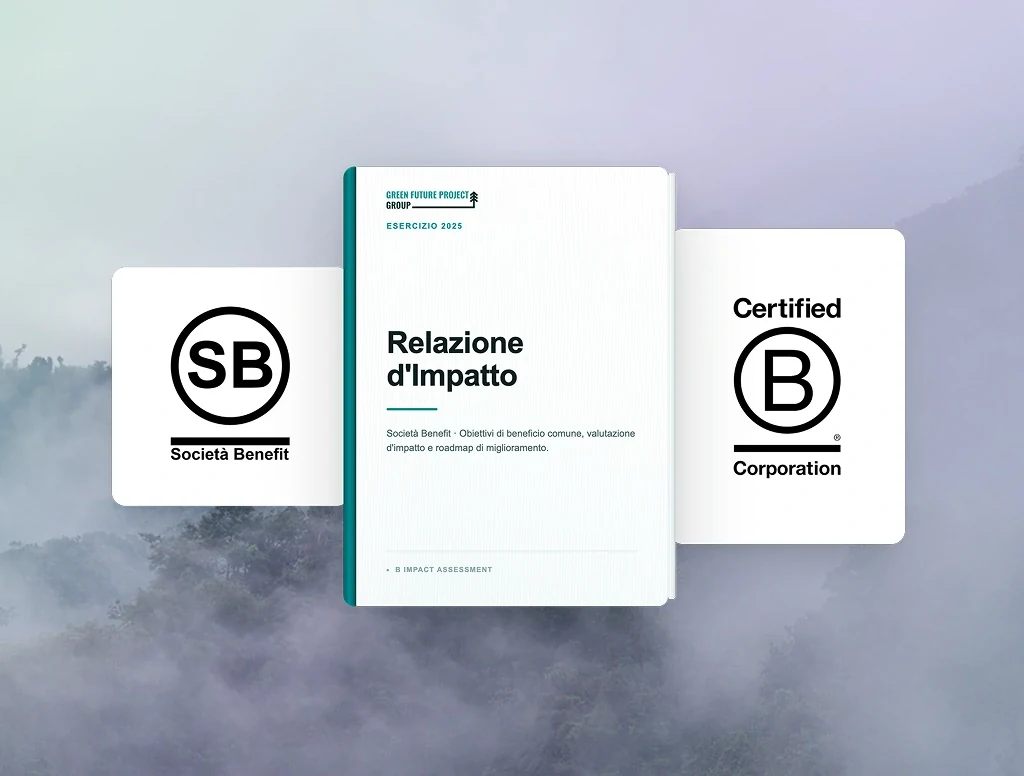
Benefit Corporation
A legal form that combines the pursuit of profit with a common benefit purpose, operating in a responsible, sustainable and transparent way towards people, communities, territories and the environment.
The intersection of the two purposes, recognised by Italian law since 2016.
In carrying out an economic activity, in addition to the purpose of sharing its profits, they pursue one or more common benefit purposes and operate in a responsible, sustainable and transparent way towards people, communities, territories and the environment, cultural and social assets and activities, bodies and associations and other stakeholders.
Art. 1, paragraph 376 — Law 208/2015
The fundamentals
Purpose, stakeholders, transparency and management: the four elements that define the Benefit Corporation model and guide the company’s commitment over time.
The Benefit Corporation form protects the company’s mission over time, committing directors to balance economic goals and common benefit purposes.
It applies to almost every type of company: joint-stock companies, limited liability companies, partnerships limited by shares, partnerships and cooperatives. It is compatible with innovative startups, while social enterprises and simplified limited liability companies (Srls) are excluded.
Annual publication of the Impact Report, which accounts for the results achieved against the common benefit goals using an independent assessment standard, as required by Law 208/2015.
Four main commitments: amend the corporate purpose by notarial deed, balance profit and common benefit, appoint an impact manager and publish the annual Impact Report.
Why do it
From reputation to sustainable finance: eight concrete benefits for companies that complete the journey.
Becoming a Benefit Corporation strengthens the company’s reputation, credibility and trust with customers, stakeholders and the market.
Measure and monitor the company’s social and environmental impact, identifying goals and opportunities for improvement.
Embed common benefit purposes, protecting the mission through leadership changes and generational handovers.
Bring the common benefit into governance, balancing economic interests with those of stakeholders, society and the environment.
Integrate sustainability into business decisions to improve efficiency and create value over the long term.
Strengthen your positioning towards sustainable finance instruments and ESG- and impact-oriented capital.
Strengthen your positioning as a Benefit Corporation with customers, suppliers, partners and sustainability-minded supply chains.
Access the rewards granted to Benefit Corporations in specific tenders, public procurement and public initiatives.
The impact report is first and foremost a tool for self-assessment and planning, as well as a safeguard against change.
The journey
Nine stages that take the company from defining its purpose to writing the Impact Report, with a dedicated contact at every step.
Defining the company’s purpose and identifying the relevant stakeholders.
Analysing impacts and identifying the material topics for the company and its stakeholders.
Defining the common benefit purposes, the goals and their targets.
Amending the corporate purpose and supplementing the articles of association by notarial deed.
Integrating the common benefit goals and their KPIs into the company’s Business Plan.
Drafting or amending the articles of association to include the common benefit purposes required by law.
Aligning governance and people with the goals and commitments of the Benefit Corporation.
Defining actions, responsibilities and KPIs to monitor progress towards the goals.
Measuring results and writing the annual Impact Report required for Benefit Corporations.
Impact Report
The Impact Report is the annual document in which a Benefit Corporation reports on how it has pursued its common benefit purposes, the actions taken and the results achieved, assessing its impact on people, communities, the environment and other stakeholders.
The report accompanies the financial statements and makes it possible to track the Benefit Corporation’s goals over time through indicators and an external assessment standard.
The phenomenon in Italy
Registered Benefit Corporations in Italy grew from 442 in 2019 to 5,540 in 2025, an average annual growth of 20%.
B Corp
B Corp™ is a certification issued by B Lab that assesses a company’s overall impact on workers, communities, the environment and customers. Unlike the Benefit Corporation, it is not a legal form but a voluntary certification.

The comparison
Benefit Corporations pursue the same goals as B Corps but, unlike them, are required to act in accordance with specific legal provisions.
A corporate model provided for and regulated by Italian law, which writes one or more common benefit purposes into the articles of association, together with the related management and reporting obligations.
A company that has obtained the certification issued by B Lab, following an assessment of its overall impact on workers, communities, the environment and customers.
How they combine
Legal form and certification can coexist or exist separately: three configurations a company can take.
The most complete configuration: the certification attests the performance, the legal form binds it into the articles of association.
The company obtains the certification without amending its articles of association.
Note To keep the B Corp certification in Italy, the company must become a Benefit Corporation within two years of being certified.
The company adopts the legal form and its obligations, without starting the certification process.
FAQ
The questions companies ask us most often before starting the journey.
Benefit Corporation and B Corp
Tell us about your company and your goals: together we will assess whether the Benefit Corporation form, B Corp certification or both are the right path.
We have received your request. An ESG expert from Green Future Project Group will contact you within 24 working hours.