Strategic advisory

EUDR and PPWR: regulatory compliance

EUDR and PPWR introduce new obligations for raw materials and packaging. We help companies achieve compliance, from supplier traceability to packaging redesign.

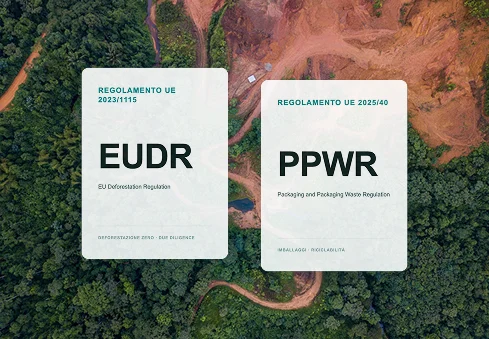
EUDR & PPWRReg. (EU) 2023/1115 · 2025/40

The context

EUDR and PPWR

Two regulations with different subjects but a similar logic. Both become applicable in 2026 for medium and large companies, shift the focus upstream in the supply chain and require verifiable primary data from suppliers and partners: estimates are no longer enough.

That is why compliance is not just a matter for the compliance function: it involves purchasing decisions, supplier management and product design.

Functions involved
  • Procurement
  • Supply chain
  • Product development

Fully applicable in 2026

PPWR applies from 12 August 2026; EUDR from 30 December 2026 for medium and large companies.

Focus upstream in the supply chain

Obligations depend on how materials and goods are produced, not just on how they are sold.

Primary, verifiable data

Geolocation and traceability of raw materials for EUDR, packaging composition and recyclability for PPWR: the data has to be collected from suppliers.

02EUDR

What EUDR is and how it works

The EU Deforestation Regulation prohibits placing on the EU market, or exporting from the Union, certain commodities and derived products if they are linked to deforestation or forest degradation after 31 December 2020, or if they were not produced in accordance with the laws of the country of origin. Whoever first places the product on the market must prove this through a due diligence process based on the geolocation of the plots of production.

Legal references
  • Regulation (EU) 2023/1115 Establishes the EUDR
  • Regulation (EU) 2025/2650 Postponed application and simplifications, published on 23 December 2025

The scope

Commodities at high risk of deforestation and their derived products.

  • Cattle
  • Wood
  • Cocoa
  • Soy
  • Palm oil
  • Coffee
  • Natural rubber
  • and their derived products
31/12/2020Cut-off date: products must not come from land deforested after this date.
7Commodities in scope, with their derived products listed in Annex I
GeolocationCoordinates of the plots of production, required in the due diligence statement

Risks and penalties

What companies risk if they fail to comply with EUDR

Ban on placing on the market

Without a due diligence statement, products in scope cannot be sold or exported.

Held at customs

Authorities can stop goods that lack the statement's reference number.

Fines of up to 4% of EU turnover

Along with confiscation of products and temporary exclusion from public procurement and public funding.

Loss of competitiveness

Suppliers without geolocation and traceability data expose the entire supply chain to the risk of exclusion from the European market.

Our support

How we support you on EUDR

Three areas of work, available separately or combined into a single programme.

Scope and supply chain role analysis

We assess the company's exposure and the obligations that apply.

  • Mapping of CN codes and products in scope
  • Role definition: operator, downstream operator or trader
  • Check of company size and applicable deadline

Supplier due diligence and traceability

We engage suppliers to collect verifiable data on origin.

  • Questionnaires and collection of geolocation data
  • Risk assessment by country of origin and supplier
  • Definition of risk mitigation measures

Statements and monitoring

We oversee obligations and the evolution of the regulation.

  • Support with the due diligence statement in the Information System
  • Management of reference numbers along the downstream supply chain
  • Updates on delegated acts, guidelines and country benchmarking

Supplier data collection can be managed with ESG Supply Chain Analytics.

03PPWR

What PPWR is: the EU Packaging Regulation

The Packaging and Packaging Waste Regulation sets uniform rules across the Union on the design, recyclability, labelling and end of life of all packaging placed on the market, regardless of material. As a regulation, it applies directly in all Member States and replaces Directive 94/62/EC.

Regulation (EU) 2025/40
  • Publication 22 January 2025
  • Entry into force 11 February 2025
  • Full application 12 August 2026

Reduce waste at source

Minimising the weight, volume and empty space of packaging.

Encourage reuse

Reuse and refill targets for specific packaging categories.

Ensure high-quality recycling

Recyclability performance grades and minimum recycled content.

Binding targets

Reduction of packaging waste per capita

Targets set at EU level against 2018 values, which will shape design and sourcing choices in the coming years.

−5%By 2030
−10%By 2035
−15%By 2040

Risks and penalties

What companies risk if they fail to comply with PPWR

Ban on placing on the market

Packaging below the minimum recyclability threshold cannot be sold: 70% from 2030, 80% from 2038.

Restrictions on single-use and over-packaging

Limits on specific single-use formats, on empty space and on solutions that increase perceived volume.

Administrative penalties

Member States set penalties for non-compliance of packaging, documentation and labelling.

Exclusion from tenders and calls

ESG criteria in procurement and supply contracts penalise non-compliant or undocumented packaging.

Who it applies to
  • Manufacturers
  • Producers
  • Importers
  • Distributors
  • Logistics operators
  • HORECA
  • SMEs included

Our support

How we support you on PPWR

From a snapshot of your current packaging to a packaging sustainability strategy.

Packaging analysis and gap analysis

We assess the packaging in use against the requirements of the Regulation.

  • Inventory of formats, materials and suppliers
  • Assessment of recyclability and recycled content
  • Identification of non-compliances and priorities

Integrated sustainability strategy

We turn compliance into a product improvement project.

  • Packaging restyling and redesign
  • Sourcing of recycled materials
  • Integration with LCA and carbon footprint

Regulatory monitoring and documentation support

We guide the company as delegated acts evolve.

  • Declaration of conformity and technical documentation
  • Harmonised labelling requirements
  • Updates on delegated acts and guidelines

FAQ

Frequently asked questions

The questions companies ask us most often about EUDR and PPWR.

EUDR is Regulation (EU) 2023/1115 on deforestation-free products, amended by Regulation (EU) 2025/2650. It prohibits placing on the EU market, or exporting, cattle, wood, cocoa, soy, palm oil, coffee, natural rubber and their derived products if they come from land deforested or degraded after 31 December 2020 or if they were not produced in accordance with the laws of the country of origin.
Due diligence obligations fall on the operators that first place products in scope on the EU market. The application dates are 30 December 2026 for medium and large companies and 30 June 2027 for micro and small enterprises, except for wood products already covered by the EUTR.
Following the 2025 revision they are exempt from due diligence, but they must collect and keep the reference number of the statement received from the upstream supplier. Downstream operators and traders that are not SMEs must also register with the EUDR Information System.
It is Regulation (EU) 2025/40 on packaging and packaging waste, published on 22 January 2025, in force since 11 February 2025 and fully applicable from 12 August 2026. It sets uniform requirements on design, recyclability, recycled content, reuse and labelling for all packaging placed on the EU market.
Yes. PPWR repeals Directive 94/62/EC. Unlike a directive, a regulation applies directly and identically in all Member States, with no need for national transposition.
EUDR concerns companies that place products in scope on the EU market or export them, with lighter obligations for those operating downstream in the supply chain. PPWR applies to every operator in the packaging chain: manufacturers, producers, importers, distributors, logistics operators and HORECA, SMEs included. Many companies in the food, furniture and fashion sectors are subject to both.

EUDR and PPWR

Let's review your company's obligations together

Tell us which raw materials you trade and which packaging you place on the market: we will assess your exposure, deadlines and priorities for action.

  • A 30-minute call with an expert, no commitment
  • We get back to you within 24 working hours
  • A first concrete direction for your ESG goals
This field is required.
Please enter a valid email.
This field is required.

No spam. Your data is processed in accordance with the GDPR.

Thank you, we will be in touch

We have received your request. An ESG expert from Green Future Project Group will contact you within 24 working hours.