Strategic advisory

ESG rating for companies

EEnvironmentalSSocialGGovernance

A sustainability rating built on 11 analysis modules that turns environmental, social and governance data into a clear, comparable ESG score you can use in business decisions.

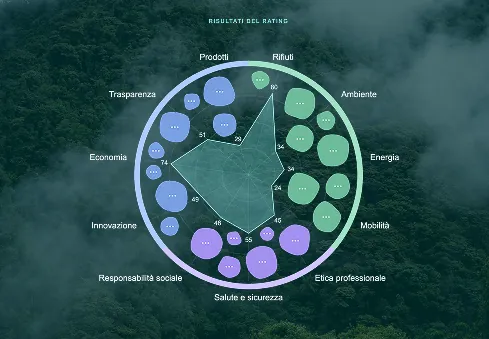
ESG Rating11 modules · Score 0–100

Definition

What an ESG rating is

An ESG rating is an assessment, expressed as a score from 0 to 100 and a rating class, that measures a company’s ability to identify and manage risks and opportunities across the Environmental, Social and Governance dimensions.

It is based on a scheme accredited by Accredia, compliant with ISO/IEC 17029, ISO/TS 17033 and UNI/PdR 102, and it integrates the main international frameworks.

The assessment highlights gaps against best practices, regulatory requirements and reference standards, and identifies the priority areas for action.

Measurement areas

11 modules · Score 0–100
E

Environmental

4 modules

Environmental impacts of the business

  • Emissions
  • Energy
  • Waste
  • Mobility
S

Social

3 modules

People, communities and relationships

  • Health and safety
  • Social responsibility
  • Professional ethics
G

Governance

4 modules

Management, control and business model

  • Transparency
  • Economics
  • Innovation
  • Products
Overall ESG score and rating class

The process

How to obtain an ESG rating

01

Questionnaire

Guided completion starting from the VAT number, collecting ESG data, policies and quantitative indicators.


02

Evidence

Upload of the documentation supporting the answers provided.

03

Analysis

Calculation of the ESG score, gap analysis by pillar and review by our consultants.

04

Feedback

Sharing of the rating report, review of the results with our consultants and definition of operational recommendations.

The rating can be verified by an independent third-party body, for a higher level of assurance towards customers, banks and investors.

The report

ESG rating: a sample report

At the end of each module a personalised report is generated. It shows the issues found, the improvements you can make and the criteria met, with a reference to the standards and regulations linked to each question.

It also includes a benchmark against the Italian and European averages, the sector and companies of the same size.

Benchmark included

  • Italian average
  • European average
  • Sector
  • Companies of the same size
SSocialModule 06

Social responsibility

73/100
2Issues and risks
4Feasible improvements
8Criteria met
Solution #3.4.0Expert advice

Formalise a policy for local community initiatives, with objectives and monitoring indicators.

Improvement

How to improve your ESG rating

The rating is not a finish line. It is the basis on which our consultants build the improvement path.

01

Identification of the main ESG gaps and intervention priorities

02

A structured, measurable improvement roadmap

03

Definition of ESG KPIs and targets

05

Integration of ESG data into decision-making and strategic processes

Why do it

The benefits of an ESG rating for Italian companies

Market

Access to capital

Present your company to banks, investors and lenders in a more structured and transparent way.

Credibility

Turn your ESG commitment into objective, concise evidence you can communicate.

Customer and supply chain requests

Organised data and evidence to answer ESG questionnaires from customers and financial institutions faster.

Governance and compliance

Stronger claims

A documented, verifiable basis for sustainability claims, in line with Directive (EU) 2024/825.

Model 231

The rating results become indicators for verifying governance processes and help the Supervisory Body monitor risks.

Business continuity

A tool for directors to monitor ESG signals and vulnerabilities that may affect the going concern.
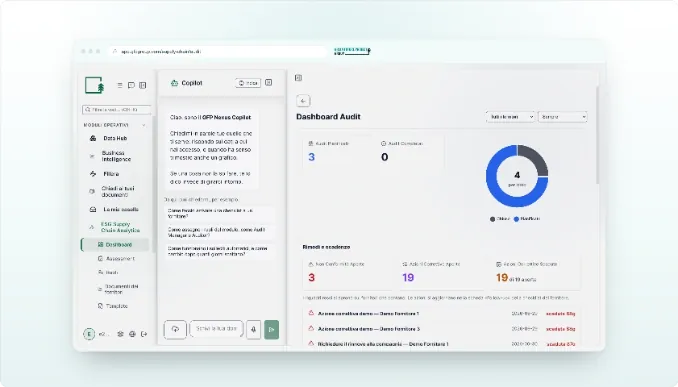
ESG Suite module

Want to assess your suppliers too?

With ESG Supply Chain Analytics you monitor the ESG rating of your supply chain in real time, for each company and for the group.

Discover Supply Chain Analytics

FAQ

Frequently asked questions about ESG ratings

Answers to the most common questions on how an ESG rating is calculated, obtained and improved.

An ESG rating is an assessment, expressed as a letter grade and a score from 0 to 100, that measures how well a company can identify, manage and mitigate environmental, social and governance risks and opportunities. It highlights the areas that deviate from best practices, regulatory requirements and reference standards, and shows where to act first.
The rating is based on 11 analysis modules: Waste, Energy, Environment and Mobility for the Environmental pillar; Health and safety, Social responsibility and Professional ethics for the Social pillar; Economics, Transparency, Innovation and Products for the Governance pillar. Each module collects data through a questionnaire and returns a score from 0 to 100. The scores are aggregated by E, S and G pillar and feed into the overall ESG score, expressed on a scale of risk classes from AAA (very low risk) to C (very high risk).
The process has four phases: guided completion of the questionnaire starting from the VAT number, upload of the supporting documentation for each answer, analysis with score calculation and consultant review, and delivery of the report with the review of the results and operational recommendations. The rating can also be verified by an independent third-party body.
ESG ratings are issued by three types of organisations: ESG rating agencies, which mainly assess large and listed companies for investors and financial markets; supply chain assessment platforms, which qualify suppliers through questionnaires requested by customers and lead companies; and accredited schemes with advisory support, such as GFP Group's approach, designed for SMEs as well and verifiable by a third party.
They are synonyms. The term “ESG” spells out the three pillars measured: Environmental, Social and Governance.
The ESG score indicates the company's level of ESG risk, both overall and for each pillar. For example, class BBB corresponds to a score between 45 and 54 out of 100, i.e. a medium/low risk.
You start from the rating results: gap analysis to identify intervention priorities, a structured and measurable improvement roadmap, definition of ESG KPIs and targets, and periodic updates of the assessment to measure progress over time.
Yes. Banks and customers increasingly ask for an ESG rating even from companies that are not required to publish sustainability reports. The benchmark included in the report compares the results with Italian companies in the same sector and of the same size.
An ESG rating is usually updated once a year, in line with the reporting cycle, to measure the progress achieved and keep the data aligned with the requests of banks, customers and investors.

ESG Rating

Request your ESG rating

Tell us about your company: we will suggest the most suitable assessment path and the timeline to obtain your ESG score.

  • A 30-minute call with an expert, no commitment
  • We get back to you within 24 working hours
  • A first concrete direction for your ESG goals
This field is required.
Please enter a valid email.
This field is required.

No spam. Your data is processed in accordance with the GDPR.

Thank you, we will be in touch

We have received your request. An ESG expert from Green Future Project Group will contact you within 24 working hours.